Google Scholar 4 citations 1 h-index 0 i10-indexsynced Oct 8, 2026

2026

MaRK: Markov-adapted Recurrent Kernels for Dynamic Operator Conditioning in State Space Models

Syed Ibrahim Omer, Ginny Y. Wong, Xiangyu Zhao

Advances in Neural Information Processing Systems 39 (NeurIPS 2026) — Poster

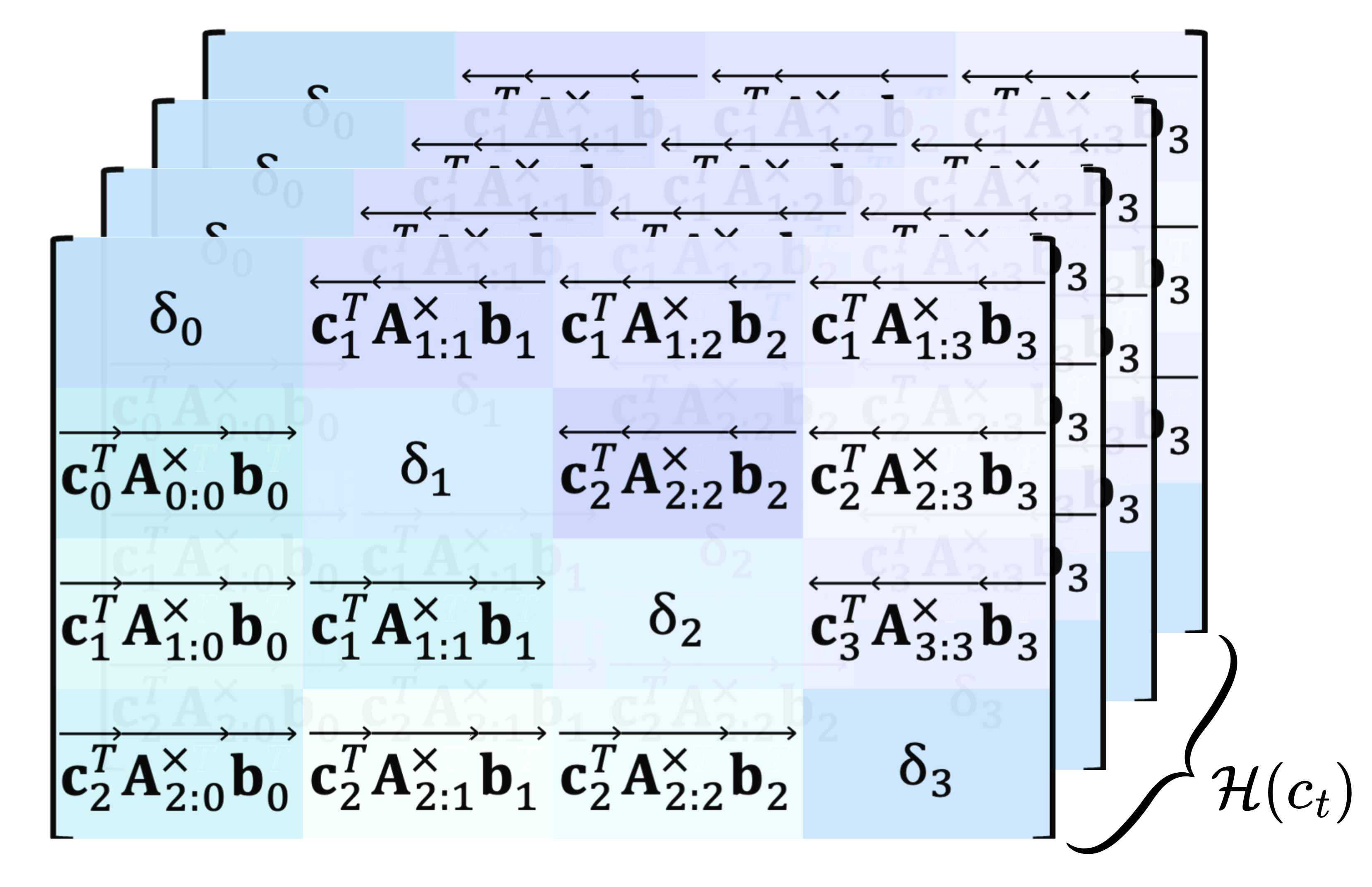
State Space Models (SSMs) offer an efficient alternative to Transformers for sequence modeling, yet conditioning pre-trained SSMs for iterative generation typically operates outside the recurrent operator, through input injection or activation modulation. While such mechanisms expose the model to conditioning information, they leave the underlying temporal dynamics fixed. We introduce MaRK (Markov-adapted Recurrent Kernels), a dynamic operator-conditioning framework that maps context vectors directly into bounded modulations of a frozen SSM's recurrence ($A$), read-in ($B$), read-out ($C$), skip ($D$), and discretization ($\Delta$) parameters. Viewed through the lens of Linear Parameter-Varying systems, MaRK induces a context-indexed family of Markov parameter sequences, allowing each diffusion timestep to reshape the model's input-output memory kernel. We instantiate MaRK on a frozen 111M-parameter Hydra SSM backbone and study three adapter geometries: Hypernet, Chebyshev polynomial, and Discrete Cosine Transform kernels. Since these adapters modify the Markov parameter sequence through low-rank auxiliary maps on the frozen backbone, parameter-efficient fine-tuning arises as a structural consequence of the adaptation mechanism itself, requiring only 6.3--11M trainable auxiliary parameters to transition from a bidirectional objective to an iterative diffusion regime. The bounded recurrence parameterization further yields an analytic Affine Quadratic Stability certificate for the modulated recurrence. Through synthetic LPV recovery experiments and Markov-operator diagnostics, we show that MaRK recovers coordinate-invariant temporal operators under matched assumptions and produces distinct, stable timestep-conditioned memory profiles. Empirically, the Chebyshev variant yields the strongest performance, achieving an average validation loss of 2.55, followed by the DCT (2.59) and Hypernet (3.77) geometries. Together, these results provide initial evidence that dynamic operator modulation is a principled operator-level conditioning mechanism for adapting SSMs beyond input-stream injection and adaptive normalization.

MaRK: Markov-adapted Recurrent Kernels for Dynamic Operator Conditioning in State Space Models

Syed Ibrahim Omer, Ginny Y. Wong, Xiangyu Zhao

Advances in Neural Information Processing Systems 39 (NeurIPS 2026) — Poster

State Space Models (SSMs) offer an efficient alternative to Transformers for sequence modeling, yet conditioning pre-trained SSMs for iterative generation typically operates outside the recurrent operator, through input injection or activation modulation. While such mechanisms expose the model to conditioning information, they leave the underlying temporal dynamics fixed. We introduce MaRK (Markov-adapted Recurrent Kernels), a dynamic operator-conditioning framework that maps context vectors directly into bounded modulations of a frozen SSM's recurrence ($A$), read-in ($B$), read-out ($C$), skip ($D$), and discretization ($\Delta$) parameters. Viewed through the lens of Linear Parameter-Varying systems, MaRK induces a context-indexed family of Markov parameter sequences, allowing each diffusion timestep to reshape the model's input-output memory kernel. We instantiate MaRK on a frozen 111M-parameter Hydra SSM backbone and study three adapter geometries: Hypernet, Chebyshev polynomial, and Discrete Cosine Transform kernels. Since these adapters modify the Markov parameter sequence through low-rank auxiliary maps on the frozen backbone, parameter-efficient fine-tuning arises as a structural consequence of the adaptation mechanism itself, requiring only 6.3--11M trainable auxiliary parameters to transition from a bidirectional objective to an iterative diffusion regime. The bounded recurrence parameterization further yields an analytic Affine Quadratic Stability certificate for the modulated recurrence. Through synthetic LPV recovery experiments and Markov-operator diagnostics, we show that MaRK recovers coordinate-invariant temporal operators under matched assumptions and produces distinct, stable timestep-conditioned memory profiles. Empirically, the Chebyshev variant yields the strongest performance, achieving an average validation loss of 2.55, followed by the DCT (2.59) and Hypernet (3.77) geometries. Together, these results provide initial evidence that dynamic operator modulation is a principled operator-level conditioning mechanism for adapting SSMs beyond input-stream injection and adaptive normalization.

2025
Redefining Hybrid Blockchains: A Balanced Architecture

Syed Ibrahim Omer

ArXiv 2025 Cited by4

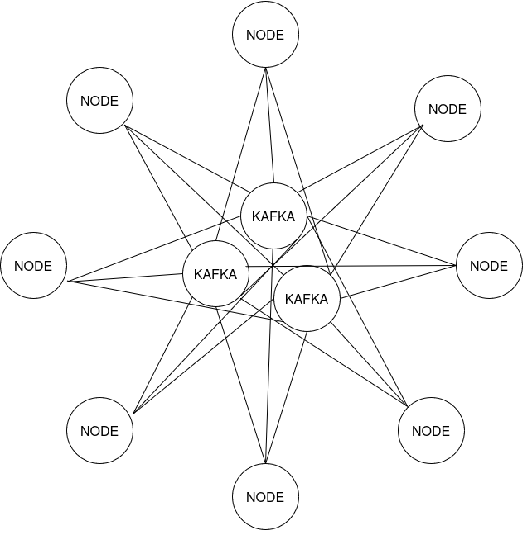
Blockchain technology has completely revolutionized the field of decentralized finance with the emergence of a variety of cryptocurrencies and digital assets. However, widespread adoption of this technology by governments and enterprises has been limited by concerns regarding the technology's scalability, governance, and economic sustainability. This paper aims to introduce a novel hybrid blockchain architecture that balances scalability, governance, and decentralization while being economically viable for all parties involved. The new semi-centralized model leverages strategies not prevalent in the field, such as resource and node isolation, containerization, separation of networking and compute layers, use of a Kafka pub-sub network instead of a peer-to-peer network, and stakes-based validator selection to possibly mitigate a variety of issues related to scalability, security, governance, and economic sustainability. Simulations conducted on Kubernetes demonstrate the architecture's ability to achieve over 1000 transactions per second, with consistent performance across scaled deployments, even on a lightweight consumer-grade laptop with resource constraints. The findings highlight the system's scalability, security, and economic viability, offering a robust framework for enterprise and government adoption.

Redefining Hybrid Blockchains: A Balanced Architecture

Syed Ibrahim Omer

ArXiv 2025 Cited by4

Blockchain technology has completely revolutionized the field of decentralized finance with the emergence of a variety of cryptocurrencies and digital assets. However, widespread adoption of this technology by governments and enterprises has been limited by concerns regarding the technology's scalability, governance, and economic sustainability. This paper aims to introduce a novel hybrid blockchain architecture that balances scalability, governance, and decentralization while being economically viable for all parties involved. The new semi-centralized model leverages strategies not prevalent in the field, such as resource and node isolation, containerization, separation of networking and compute layers, use of a Kafka pub-sub network instead of a peer-to-peer network, and stakes-based validator selection to possibly mitigate a variety of issues related to scalability, security, governance, and economic sustainability. Simulations conducted on Kubernetes demonstrate the architecture's ability to achieve over 1000 transactions per second, with consistent performance across scaled deployments, even on a lightweight consumer-grade laptop with resource constraints. The findings highlight the system's scalability, security, and economic viability, offering a robust framework for enterprise and government adoption.